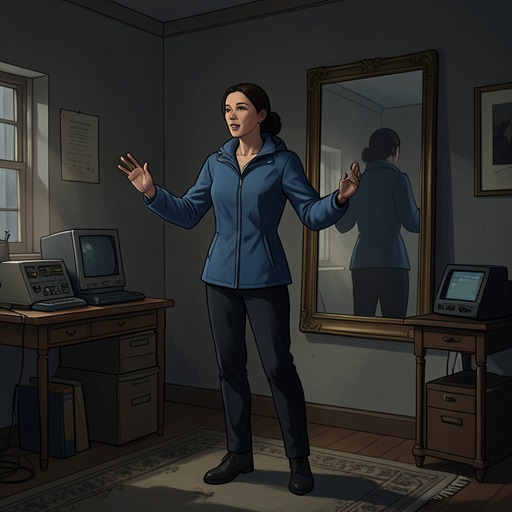
Ever’s Mother
Loveboat, TaipeiEver’s Mother shapes Ever’s summer in Taiwan through a form of care that is both tangible and controlling: she arranges the trip in the name of cultural connection, sells a treasured heirloom to pay for it, and tries to set aside the dance life her daughter is struggling to claim. The novel does not reduce her to an obstacle. Her worry about Ever’s future grows from love and sacrifice, yet the way she acts leaves little room for Ever’s own decisions—a tension that resonates with the story’s broader insistence that love cannot require one person to bear another’s life alone.
Identity and Family Expectations
Ever’s Mother is a Chinese American parent who believes her daughter should understand her heritage and pursue a secure future. When Ever is discovered wearing makeup and concealing a letter, her mother arrives from the kitchen with a printout and immediately notices the small sign of independence. The detail of the jade-green blouse, buttoned to its modest neckline, accompanies a familiar pattern: Ever anticipates her mother’s scrutiny and hides even her lip gloss until she is safely away from home.
Her expectations come into sharp focus when she learns that Ever has been admitted to Northwestern University’s medical program but has also received a dance offer from Tisch School of the Arts. She asks whether the dance letter explains why Ever got into only one medical school, then condemns dancing as a path with no future. She invokes Agatha, an older woman from church who attends free senior lunches and recalls her days with the Cleveland Ballet, as a warning of what an insecure life in dance might look like. The example reveals her fear in concrete terms: she is not merely defending a convention, but imagining the material consequences of a career she considers precarious.
Sending Ever to Taiwan
Ever’s Mother presents the trip as a chance for her daughter to learn her culture. Ever remembers that her parents were born in Fujian and had spoken of visiting, though the family had never had the money to go; the trip to Taiwan is therefore not the family visit Ever had imagined. Her mother says that Aunty Lilian recommended the program and insists it is not a punishment. Ever, already ashamed of having dropped out of Chinese school as a child, hears the plan as an imposed solution to her cultural distance rather than an invitation she chose.
The cost makes the decision’s emotional stakes unmistakable. When Ever protests that the ticket has already been bought, her mother says she sold her black pearl necklace. The necklace had been a gift from her own father, who died when she was fifteen; she used to take it out on his death anniversary and polish the pearls with red silk. Its sale turns the trip into an act of sacrifice, but also places the weight of that sacrifice on Ever. The gesture helps explain why her mother sees the arrangement as loving and why Ever may experience it as a decision she is no longer free to refuse.
Dance, Care, and Control
That conflict becomes physical when Ever’s Mother enters the bedroom with a neck pillow, checks the suitcase, and pulls out Ever’s periwinkle dance bag. She tips the leotard and pointe shoes onto the bed and says Ever will not need them in Taiwan. The practical preparations for travel thus become an attempt to remove dance from the trip before it begins. Ever’s father has just offered a rare gesture of comfort and suggested that he might join her for the last days; the mother’s brisk intervention displaces that tentative reassurance with her own plan for what Ever should bring—and what she should leave behind.
Later, Ever tells Xavier that her parents are trying to fly her home after having forced her to come to Taiwan, just as she has finally assembled a group of dancers and begun to feel at home. This account shows how the original decision continues to define their relationship: the trip that was meant to draw Ever toward her culture has become the setting where she finds community through dance, making a return home feel like another interruption of her chosen life. The evidence does not establish the mother’s response to this later conflict, but it makes clear that Ever experiences parental protection as a force capable of undoing the belonging she has built for herself.
Responsibility and the Limits of Care
Ever’s Mother is also connected to the novel’s question of how much one person can be asked to carry for another. When Ever raises the possibility that Rick does not know how depressed Jenna has become, he explains that Jenna made him promise not to tell her family, whom she feared would treat her distress as weakness. Ever recognizes the bind—her own parents might not understand either—but tells Rick he cannot carry Jenna all by himself. The scene does not directly concern Ever’s Mother, yet its language provides a useful counterpoint to the family’s expectations: love and secrecy can leave a caretaker isolated unless responsibility is shared.
Rick later recounts that, during an earlier attempt to end his relationship with Jenna, she grabbed a knife and he seized it, leaving four long scars inside his fingers. He regrets not listening to his family when they warned him that the relationship was hurting Jenna and says he might have sought help sooner. His reflection brings the care question into closer alignment with Ever’s family conflict. Ever knows her parents want the best for her and recognizes that the molecular biology textbook was meant for her future and happiness, even as she cannot communicate with them across what she calls the Great Divide between American and Chinese expectations. In a separate conversation, Rick describes feeling guilty for being happy and larger in his life after Jenna, rather than remaining the smaller person he had been within their relationship. Together, these exchanges distinguish support from sole responsibility: devotion matters, but it cannot substitute for understanding, communication, or a life of one’s own.
A Relationship Not Reduced to Conflict
The novel’s glimpses of Ever’s Mother remain weighted toward the conflict over Ever’s future; they do not show a later reconciliation or a change in her position, so neither can be assumed. They do, however, complicate any reading of her as simply antagonistic. She sells an object bound to her own bereavement to finance what she believes is a valuable opportunity, and she accompanies that sacrifice with practical concern for Ever’s journey. Her actions can be loving in intention while still denying Ever a voice in choices that define her.
That unresolved tension sits beside a small sign of ordinary cooperation: Debra gives Rick a thumbs-up before the dancers perform at a fundraiser for families in Taitung affected by the typhoon. The moment is not evidence that Ever’s Mother has changed her mind about dance; it instead shows the wider network around Ever’s performance, where care can take the form of practical encouragement rather than deciding someone else’s future. Against the necklace sold and the pointe shoes removed from the suitcase, that distinction sharpens the character’s significance. Ever’s Mother loves her daughter, but the story tests whether that love can make room for Ever to choose what a future worth living looks like.